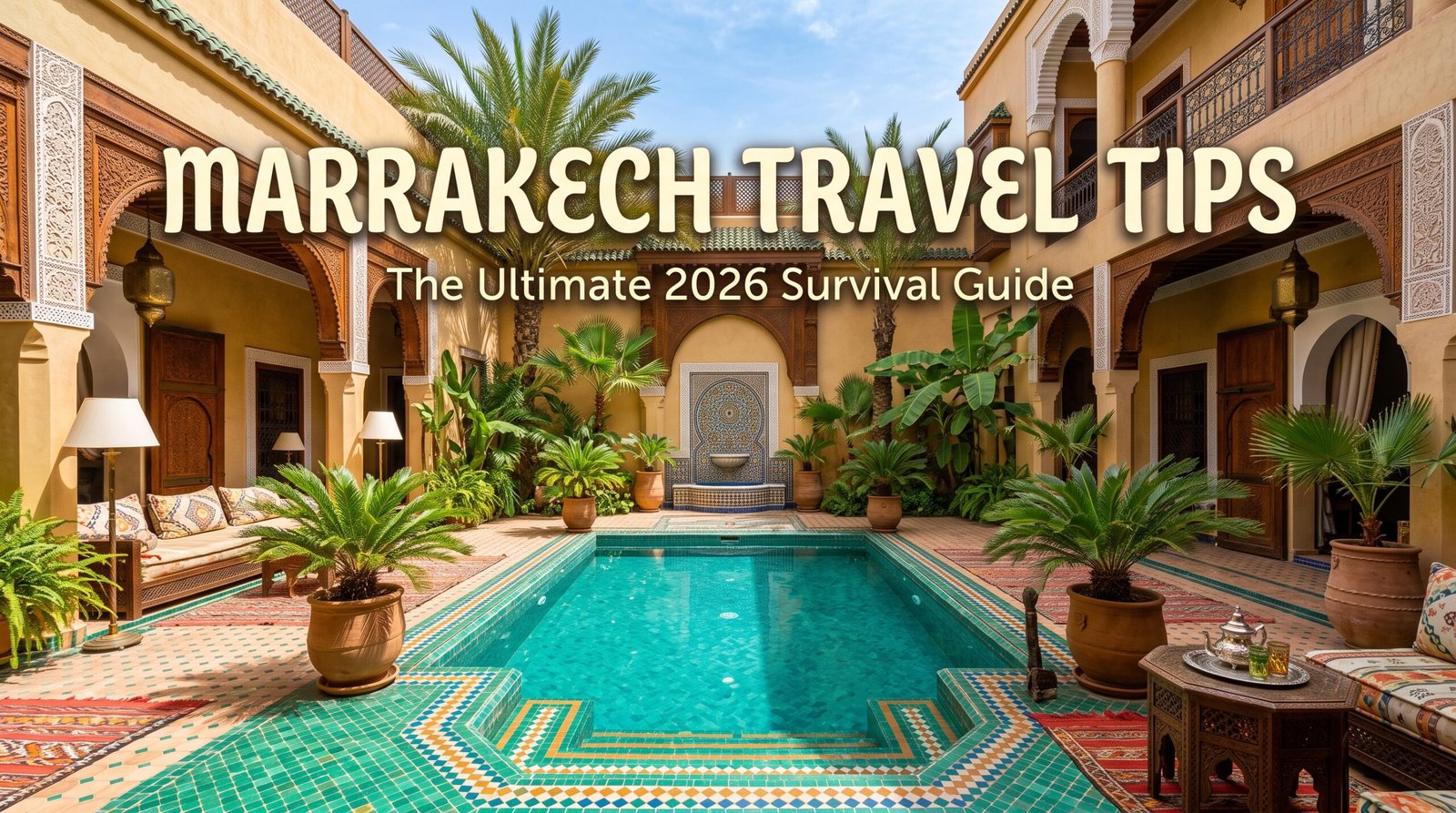
Best Marrakech travel tips in 2026
Marrakech — the Red City — has a way of hitting you all at once. The smell of cumin drifting from a souk stall, the call to prayer echoing over rooftops, the dizzying maze of narrow lanes that somehow leads you back to Jemaa el-Fna: it is a city that rewards the curious and occasionally bewilders the unprepared. If you are planning your first visit, the right Marrakech travel tips can be the difference between an overwhelming experience and the trip of a lifetime.
This guide covers everything a first-time visitor genuinely needs to know: when to go, how to arrive, where to stay, how to get around, what to eat, how to navigate the souks, which scams to watch for, and how to plan your days without burning out. It is built around practical, honest advice rather than tourist clichés — so whether you have three days or a full week, you will leave better prepared.
Use the table of contents below to jump to the section most relevant to where you are in your planning. And if you want to dive deeper into any topic, the internal links throughout this guide will point you to dedicated articles on this site.
Best Time to Visit Marrakech
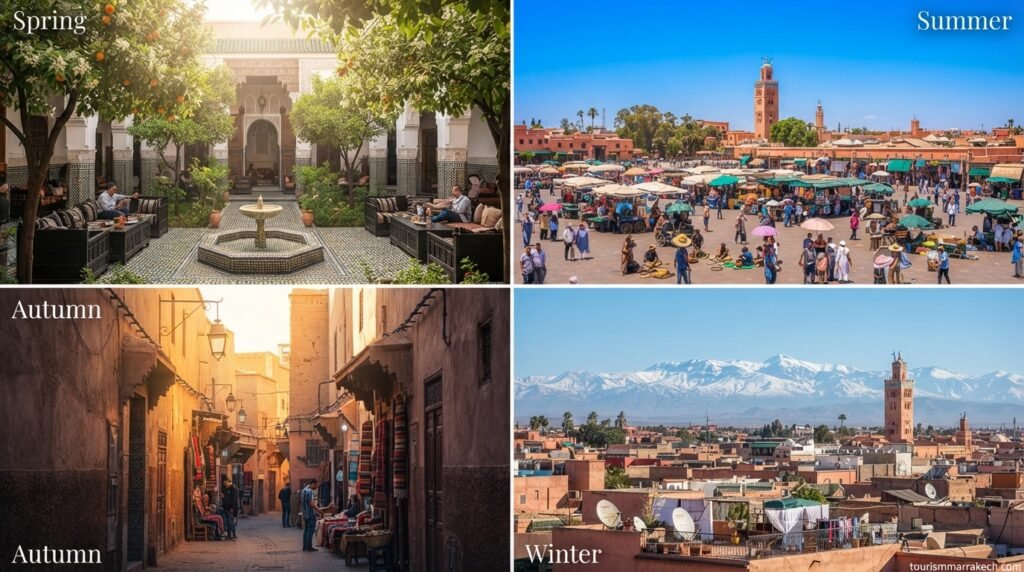
Marrakech has a semi-arid climate, which means dry weather year-round but dramatic differences in temperature between seasons. The city sits at roughly 450 metres above sea level, which moderates the heat slightly compared to the Sahara, but summers are still genuinely extreme. Most first-time visitors do best in spring or autumn.
Spring: March to May
Spring is widely regarded as the ideal window for visiting Marrakech. Daytime temperatures are comfortable — typically ranging from the mid-teens to the high twenties Celsius (low 60s to mid-80s Fahrenheit) — and the city’s gardens are at their most vibrant. Crowds are moderate compared to peak European holiday periods, and accommodation prices are reasonable outside of Easter week.
The main consideration is that Ramadan sometimes falls partially within spring (see the Ramadan section below), which can change the daily rhythm of the city significantly. If your trip overlaps, read that section carefully before you book.
Summer: June to August
Summer in Marrakech is genuinely hot. Temperatures regularly reach 38–42°C (100–108°F) in July and August, and the city’s flat terrain means there is little natural shade in open areas like Jemaa el-Fna. That said, experienced visitors find ways to enjoy summer: start early, retreat to a riad pool or hammam during the fiercest afternoon hours, and return to the streets after sunset when the city comes alive again.
The upside is that summer brings lower accommodation rates, fewer package-tour crowds, and a more local atmosphere. If you travel in summer, sun protection is non-negotiable — more on this in the packing section.
⚠️ Good to Know: July and August are the hottest months. Schedule outdoor sightseeing before noon and after 5pm. A quality hat, high-SPF sunscreen, and a reusable water bottle are essential.
Autumn: September to November
Autumn is the second-best season to visit, and many seasoned travellers actually prefer October and November to spring. The extreme heat breaks by September, crowds thin out after the European summer holidays end, and daytime temperatures settle into a very comfortable range — typically 24–30°C in September, cooling to around 18–22°C by November. Accommodation prices are often competitive and the medina feels more manageable.
Winter: December to February
Winter in Marrakech surprises many first-time visitors. Days are often clear and sunny, with temperatures around 18–22°C at midday — pleasant for sightseeing. Evenings, however, drop sharply, sometimes to near 5–8°C, and riads without central heating (which is many of them) can feel genuinely cold after dark. Pack a warm layer.
The advantage of winter is that popular attractions like Jardin Majorelle and Bahia Palace are far less crowded, and hotels often offer their lowest rates outside of Christmas and New Year periods.
Ramadan and Moroccan Holidays
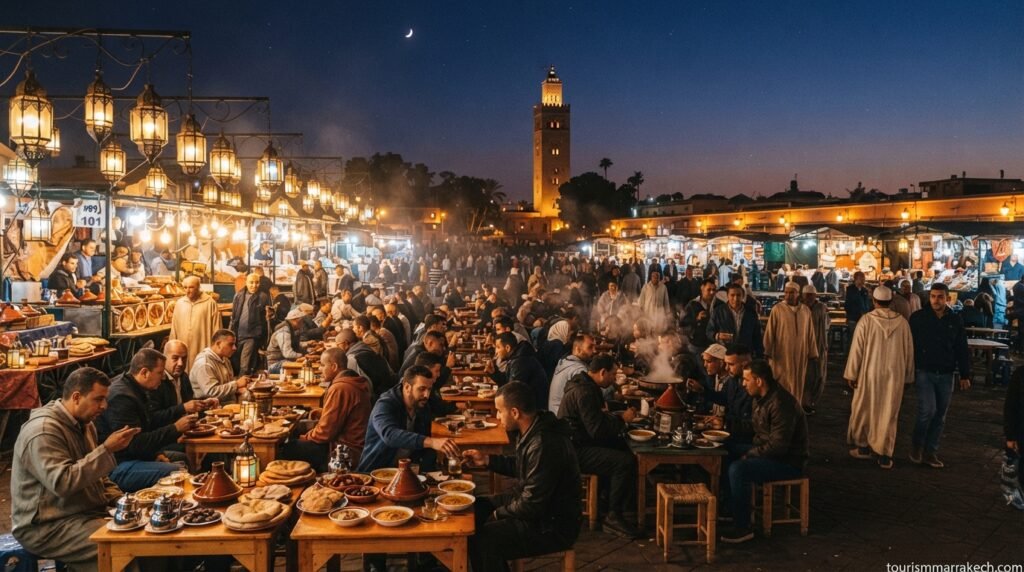
In 2026, Ramadan in Marrakech is expected to begin around February 18 and conclude around March 19, with Eid al-Fitr falling approximately on March 20. These dates are based on astronomical projections and are subject to official moon-sighting confirmation by Moroccan authorities.
Visiting during Ramadan is a genuinely fascinating experience — the medina has a completely different energy after sundown, with families gathering, street food vendors appearing at iftar (the breaking of the fast), and a warm communal atmosphere that tourists rarely see at other times. However, practical adjustments are necessary:
- Many local restaurants and cafés reduce their daytime service or close entirely during daylight hours, particularly smaller establishments serving Moroccan food.
- Hotels, riads with international clientele, and tourist-facing restaurants typically continue serving food throughout the day — but check in advance.
- Eating, drinking, and smoking in public during daylight hours is culturally disrespectful. If you need to eat or drink during the day, do so discreetly inside your accommodation or in an enclosed restaurant setting.
- Shops in the souks may open later and close for prayer periods. Expect a slower pace in the first half of the day.
- After iftar (around sunset), the medina and Jemaa el-Fna become extraordinarily lively. This is genuinely worth experiencing.
Always check current Moroccan public holiday calendars before your trip, as specific dates can affect shop hours and attraction access.
| Period | Typical Weather | Crowds | Advantages | Things to Consider |
|---|---|---|---|---|
| Spring (Mar–May) | 15–30°C, sunny | Moderate | Perfect sightseeing weather; gardens in bloom | Ramadan may overlap; Easter busy period |
| Summer (Jun–Aug) | 32–42°C, very hot | Lower | Lower prices; more local atmosphere | Extreme heat requires careful planning |
| Autumn (Sep–Nov) | 18–30°C, pleasant | Low to Moderate | Comfortable temperatures; quieter attractions | October popular with European visitors |
| Winter (Dec–Feb) | 8–22°C; cool evenings | Low (except Dec 25–Jan 1) | Less crowded; lower accommodation rates | Cold nights; some riads lack central heating |
How to Get to Marrakech and Airport Arrival Tips
Marrakech Menara Airport
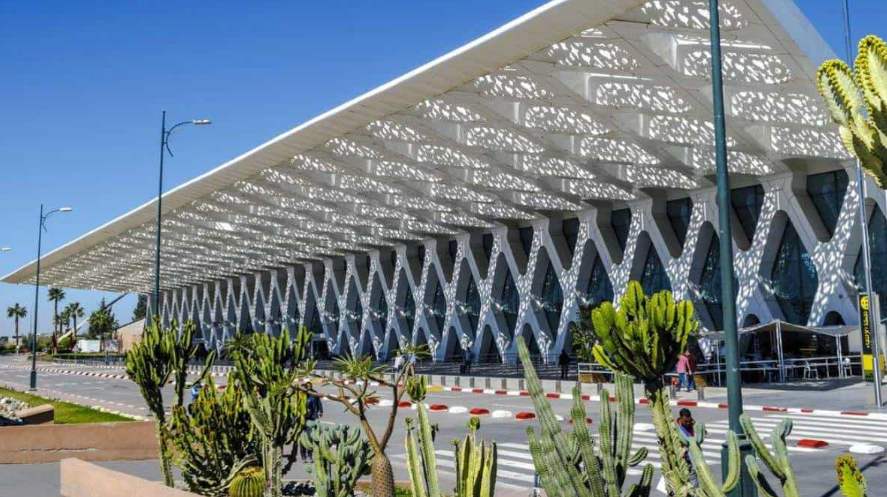
Marrakech is served by Marrakech Menara Airport (IATA: RAK), located approximately 6 kilometres from the medina. It is Morocco’s second-busiest airport, handling close to 10 million travellers annually and connecting to over 60 international destinations. The airport is modern and relatively straightforward to navigate — arrivals are clearly signposted and passport control is generally efficient, though queues can build during peak European holiday periods.
Direct flights operate from numerous UK, European, North American and Middle Eastern airports. For travellers from Australia and other long-haul markets, connections are typically made through major European or Gulf hubs. For a broader overview of getting to Morocco, see our guide on how to travel to Marrakech.
💡 Pro Tip: Download an offline map of the medina before you land. Airport Wi-Fi is free, but loading maps while managing luggage and finding your transfer is stressful. Google Maps and Maps.me both support offline Marrakech maps.
Airport Transfers
Several transport options connect the airport to the city. The right choice depends on where you are staying, what time you arrive, and how much luggage you have.
- Pre-booked private transfer: The most stress-free option, especially for first-time visitors staying in a riad inside the medina. Your driver meets you in the arrivals hall with a name sign. Note that if your riad is deep inside the medina, vehicles can only reach the nearest accessible gate — your driver will explain where to meet your riad host for the final few minutes on foot.
- Airport taxi (petit taxi): Official taxis are available from a clearly signposted rank outside arrivals. A prepaid taxi counter has operated at the arrivals exit since 2023 — you state your destination and pay a fixed price (by card or cash) before getting in, which removes the need to negotiate. Approximate fares to the city centre have typically ranged around 100–150 MAD for a daytime journey, though night surcharges apply after 20:00. Always verify the current rate at the prepaid counter.
- Public bus (Line L19/Bus 19): The most affordable option, with a fare of approximately 30 MAD, taking roughly 30–50 minutes to reach the Jemaa el-Fna area. Suitable for budget travellers with light luggage arriving during daylight hours, though not ideal if you arrive at night or with heavy bags.
- Hotel or riad pickup: Many riads arrange airport transfers on request — simply ask when booking. This is often a worthwhile convenience, especially if your riad is inside the medina and you have not navigated its lanes before.
⚠️ Good to Know: Avoid accepting rides from unlicensed drivers who approach you inside the terminal building. Always use the official taxi rank, the prepaid counter, or a pre-booked service.
Getting to Marrakech From Casablanca and Other Moroccan Cities
If you are travelling within Morocco, several options connect Marrakech to other major cities:
- Train (ONCF): A convenient and comfortable option from Casablanca. The journey takes approximately 3 hours on a direct service. Trains are generally punctual, air-conditioned, and a pleasant way to arrive. Book tickets in advance through the ONCF official website.
- CTM or Supratours bus: An affordable option from Agadir, Essaouira, and other cities. Journey times are longer than the train, but services are reliable and buses reach destinations the train network does not serve.
- Grand taxi or private transfer: For smaller towns not served by trains or regular buses, shared grand taxis are common. Private transfers offer more comfort and flexibility for families or groups.
Arrival Do’s and Don’ts
✅ Use the official taxi rank or pre-booked transfer.
✅ Have your riad or hotel address written in Arabic (ask your accommodation in advance).
✅ Download an offline map before clearing customs.
✅ Keep small banknotes accessible for tips and first purchases.
❌ Don’t accept rides from unsolicited strangers inside the terminal.
❌ Don’t change money with unofficial street changers outside the airport.
❌ Don’t assume your vehicle can drive to your riad’s front door if it is inside the medina.
Where to Stay in Marrakech
Marrakech has several distinct neighbourhoods, each with a very different atmosphere. Choosing the right area to stay is one of the most important decisions in planning your trip — it affects how easily you can reach the main sights, what your daily experience feels like, and what type of accommodation is available to you.
Medina
Staying inside the ancient walled medina puts you at the heart of everything. The historic souks, palaces, mosques, and Jemaa el-Fna are all within walking distance. The accommodation here is almost exclusively riads — traditional courtyard homes converted into guesthouses — which offer a uniquely Moroccan experience.
The trade-off is navigational: the medina’s lanes are narrow, labyrinthine, and not vehicle-accessible beyond certain gates. Scooters and handcarts frequently share the same footpaths as pedestrians. Noise can be significant in the areas around Jemaa el-Fna, particularly in the evening. For most first-time visitors, though, the medina’s atmosphere and convenience make it the best base.
Gueliz
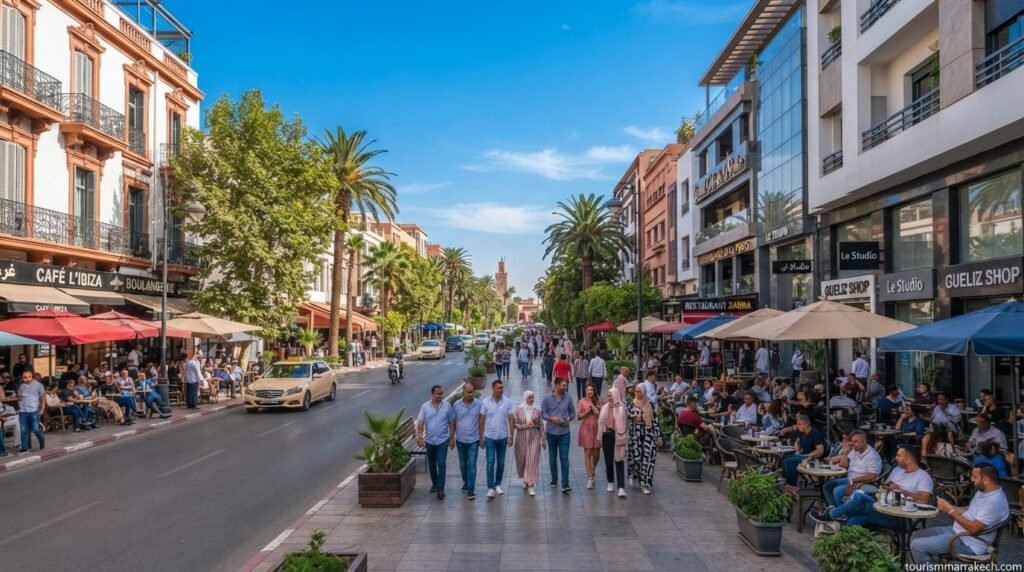
Gueliz is Marrakech’s modern district, developed during the French colonial period and located to the northwest of the medina walls. It is home to European-style restaurants, international cafés, contemporary art galleries, and a wide range of shops. It is also significantly easier to navigate by car and taxi, with wide avenues and clear street addresses.
If you prefer a quieter, more spacious base while still being within easy reach of the medina (typically 10–15 minutes by petit taxi), Gueliz is an excellent choice — particularly for travellers who find the medina’s density overwhelming.
Hivernage
Hivernage is a leafy, upmarket district adjacent to both the medina walls and Gueliz. It contains a concentration of four- and five-star hotels, evening restaurants, and the city’s main nightlife strip. It is quiet by day and more animated at night. This neighbourhood works well for travellers who want easy access to the medina but prefer international hotel-standard accommodation over riads.
La Palmeraie
La Palmeraie (the Palmery) lies several kilometres north of the city centre, amid a historic grove of palm trees. It is home to resort-style properties — many with large pools and spa facilities — that offer a tranquil contrast to the medina’s energy. The downside is distance: getting to the medina or the main attractions requires a taxi or shuttle and adds time to every outing. La Palmeraie suits travellers who want a genuine resort holiday with occasional day trips into the city, rather than those who want to explore intensively.
Riad vs Hotel
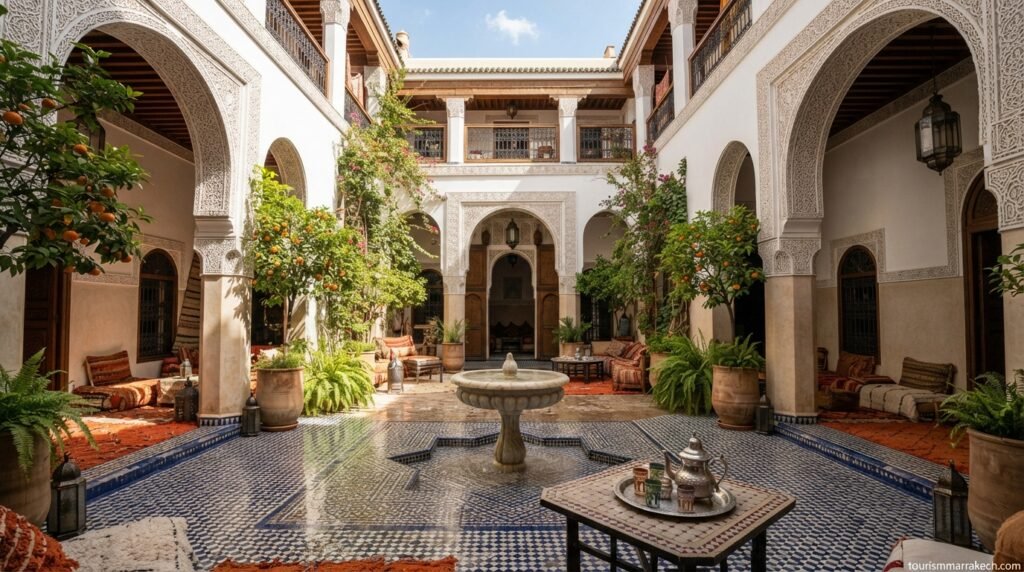
The choice between a traditional riad and a conventional hotel is one of the first things most visitors consider. Both have genuine advantages, and the right choice depends on what kind of experience you are looking for.
A riad is a traditional Moroccan house built around a central courtyard, often featuring a fountain, orange trees, mosaic tilework, and intricate carved plasterwork. Staying in one is an experience in itself. They are typically small and intimate — often 5 to 15 rooms — with attentive, personalised service. Many riads include breakfast and can arrange airport transfers, hammam sessions, and cooking classes. The limitation is that they are inside the medina, which means navigating narrow lanes with luggage and accepting that noise is part of the experience.
A hotel (particularly in Gueliz or Hivernage) offers predictable amenities: air conditioning, elevators, room service, clear addresses, and easier taxi access. If you are travelling with young children, have mobility considerations, or simply prefer a familiar hotel format, this can be the more practical choice.
| Area | Best For | Atmosphere | Transport | Main Advantage |
|---|---|---|---|---|
| Medina | First-time visitors; culture seekers | Historic; vibrant; noisy | Walking + taxis to gates | Central to all main sights |
| Gueliz | Modern amenities; extended stays | Contemporary; spacious | Easy taxi and car access | Wide restaurant and café choice |
| Hivernage | Luxury hotels; nightlife | Upmarket; quiet by day | Easy taxi access | Close to medina walls; luxury options |
| La Palmeraie | Resort holidays; families with pools | Tranquil; spacious | Requires taxi to centre | Space, pools, and resort facilities |
Getting Around Marrakech
Walking in the Medina
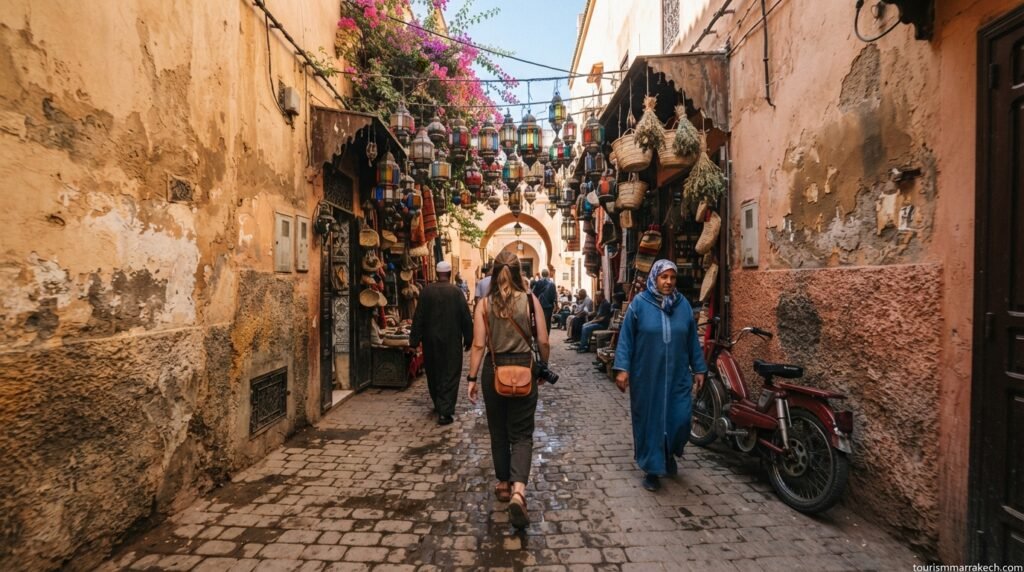
The medina is best explored on foot — it is actually the only way to reach many of its most interesting corners. The trade-off is that the lanes are narrow, frequently uneven, and shared with motorbikes, scooters, donkey-drawn carts, and other pedestrians. Stay alert, step to the side when you hear an engine, and do not assume a lane too narrow for a car is necessarily free from traffic.
Comfortable, closed-toe walking shoes are strongly recommended. Download an offline map before you start exploring — mobile data can be patchy in the densest parts of the medina, and getting orientated takes time even with navigation tools. A self-guided walking tour of Marrakech can be an excellent way to structure your first day.
Petit Taxis
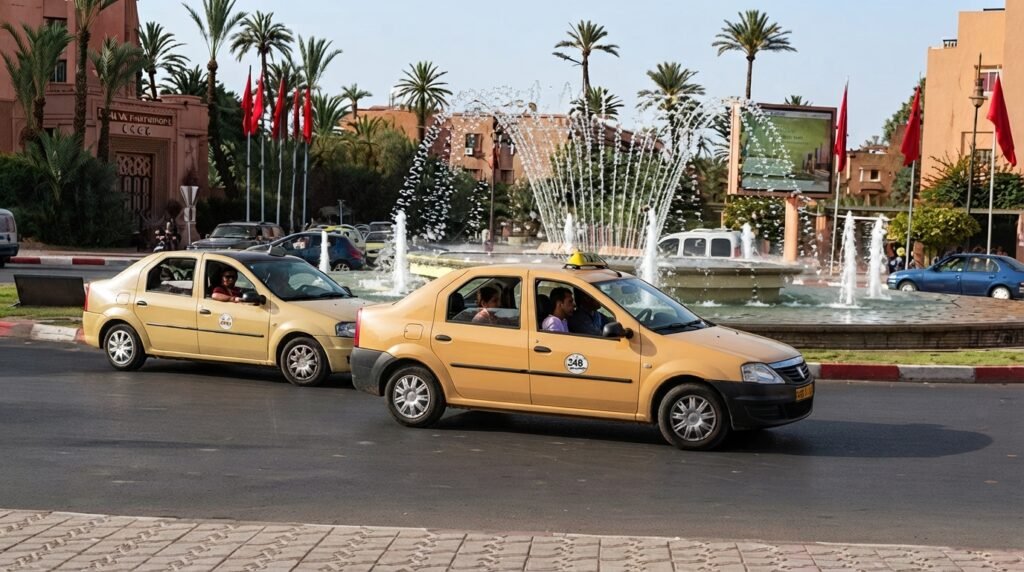
Petit taxis are small, metered cars (usually tan or beige in colour) that operate within the city. They are the most practical way to travel between the medina and Gueliz, or between different medina gates. By law, they should use their meters, though in practice some drivers will suggest a flat fare instead — always clarify and confirm the arrangement before you get in.
Taxis in Marrakech are generally inexpensive by Western standards. Fares within the city centre are typically modest, but they increase with distance and after dark (night tariffs are legal and apply after around 20:00). Hailing a taxi is straightforward on most main roads — simply wave at an approaching taxi and state your destination clearly.
Grand Taxis
Grand taxis are larger, older vehicles (often white Mercedes) that operate on fixed intercity routes as shared services, or as private hire taxis for day trips and longer journeys. They are the standard transport option for routes not served by the train, such as the trip to Essaouira or the Atlas Mountain towns. For a day trip to Imlil or Ourika Valley, you can negotiate a private grand taxi hire for the day.
Ride-Hailing Apps
The ride-hailing landscape in Marrakech has evolved significantly. As of 2026, the most reliably available app-based options are:
- inDrive: Widely used in Marrakech and other major Moroccan cities. The app uses a bidding system — you suggest a fare, and nearby drivers accept or counter. It works well in practice and is popular with both locals and visitors.
- Uber: Uber relaunched in Morocco in late 2025, with service reportedly available in Casablanca and Marrakech. However, availability can be inconsistent — do not rely solely on Uber as your primary transport option without checking current availability on the app.
- Careem and Heetch: More widely available in Casablanca and Rabat than in Marrakech. Worth checking on arrival but not guaranteed.
Be aware that official taxi drivers and ride-hailing app drivers sometimes have tensions in tourist areas. Using an app near major hotels or Jemaa el-Fna may require walking a short distance from the square to make your pickup smoother.
Public Transportation
Marrakech has a city bus network operated by Alsa, but routes are primarily designed for local commuter use rather than tourist sightseeing. The most useful bus for visitors is the Line L19 airport shuttle. For getting around the medina and between neighbourhoods, petit taxis are more practical for most travellers.
Money, Currency and Budget Tips
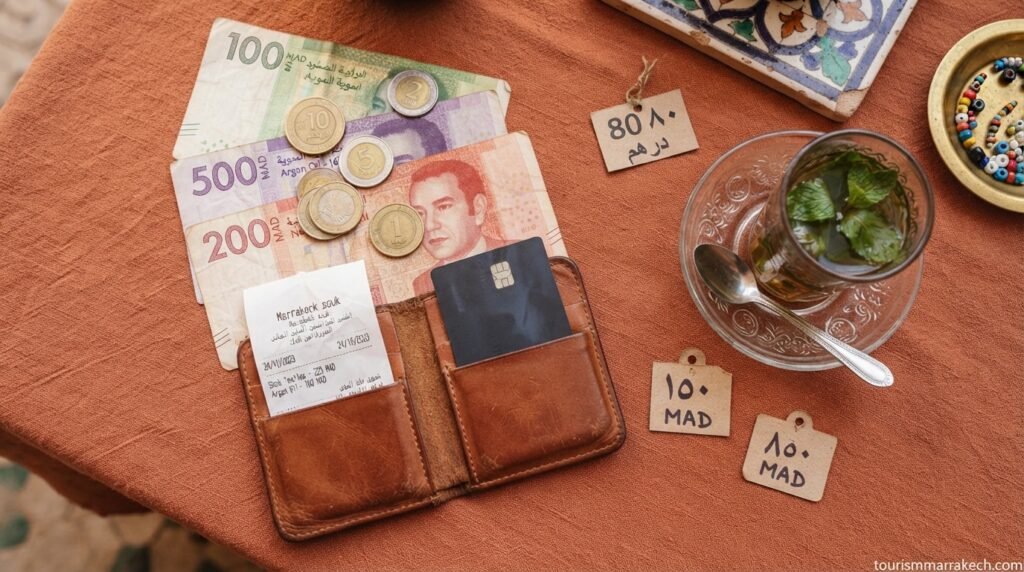
Moroccan Dirham (MAD)
Morocco’s currency is the Moroccan Dirham (MAD), abbreviated locally as “DH.” The dirham is a restricted currency, meaning it cannot legally be imported or exported in significant quantities — you exchange money on arrival and convert any remaining dirhams before departure.
ATMs are widely available in Marrakech, including at the airport, in Gueliz, and near the main medina entrances. Most international debit and credit cards work, though a transaction fee may apply. Currency exchange offices (bureaux de change) operate throughout the city and generally offer competitive rates — avoid changing money at unofficial street stalls, which may offer poor rates or counterfeit notes. Always keep your exchange receipts if you wish to convert dirhams back to your home currency on departure.
Carry Small Notes
One of the most practical Marrakech money tips is to keep a supply of small denomination notes — 10, 20, and 50 MAD — in a separate pocket from your larger bills. Stall holders in the souks, parking attendants, small café owners, and tipping situations all work in small cash. Handing a 200 MAD note for a 15 MAD purchase at a busy food stall creates awkward delays and sometimes a claim that change is unavailable. A small wallet dedicated to these smaller notes makes daily life in the medina noticeably smoother.
Credit Cards and Cash
Larger restaurants, upmarket riads, hotel boutiques, and some established shops in Gueliz accept credit cards — typically Visa and Mastercard. However, the medina souks, street food vendors, traditional hammams, and smaller local establishments operate almost exclusively in cash. Plan accordingly and always carry enough cash for a full day of activity, particularly when exploring the medina.
Tipping in Marrakech
Tipping is common and appreciated across many service contexts, though it is not compulsory. The amounts below reflect general practice rather than fixed rules.
| Situation | Customary Amount (approx.) | Notes |
|---|---|---|
| Restaurant (sit-down) | 10–15% if service not included | Check if service charge is already added |
| Café or juice bar | Round up or 5–10 MAD | Common but not expected at tourist-only venues |
| Taxi driver | Round up the fare | Not obligatory but often appreciated |
| Hotel/riad staff | 20–50 MAD per service | Appropriate for bags carried, special requests |
| Hammam attendant | 20–50 MAD | Often appreciated after a full treatment |
| Tour guide (private) | 100–200 MAD per day | Adjust based on quality and duration |
| Parking attendant | 5–10 MAD | Common for informal parking areas |
Marrakech Daily Budget
Marrakech offers good value for visitors from Western markets, but costs vary significantly depending on travel style. The ranges below are approximate guides — always verify current prices before travelling.
| Category | Budget Traveller | Mid-Range Traveller | Luxury Traveller |
|---|---|---|---|
| Accommodation | Simple guesthouse or hostel | Mid-range riad | Boutique riad or 5-star hotel |
| Food | Street food and local restaurants | Mix of local and tourist restaurants | Rooftop dining and fine Moroccan cuisine |
| Transport | Walking and occasional petit taxi | Petit taxis and occasional private transfer | Private transfers and guides |
| Activities | Free public areas; low-cost attractions | Major paid attractions; a hammam | Private tours; exclusive experiences |
| Approximate Daily Total | ~400–700 MAD (~$40–70 USD) | ~800–1,800 MAD (~$80–180 USD) | ~2,500+ MAD (~$250+ USD) |
Note: All budget figures are approximate ranges for orientation purposes only. Actual costs will depend on exchange rates, personal spending habits, and current prices. Verify before travelling.
Essential Marrakech Do’s and Don’ts
Before getting into individual topics in detail, this quick-reference section gives you the core behavioural guidelines that make the biggest practical difference in Marrakech.
| ✅ Do | ❌ Don’t | Why It Matters |
|---|---|---|
| Carry small-denomination banknotes | Rely on large notes for small purchases | Change is frequently unavailable in small stalls |
| Dress modestly in the medina | Wear short shorts or sleeveless tops in traditional areas | Respectful; reduces unwanted attention |
| Learn a few words of Darija or French | Assume everyone speaks English | A simple greeting in Darija is warmly received |
| Ask permission before photographing people | Point a camera at someone without asking | Privacy and cultural respect; some people charge a fee |
| Confirm taxi fares before starting the journey | Assume the meter will always be used | Prevents disputes on arrival at your destination |
| Negotiate respectfully in the souks | Haggle aggressively or mockingly | Friendly negotiation is expected; aggression creates conflict |
| Keep valuables secure in the medina | Carry a visible camera bag or open backpack | Petty theft targets distracted tourists |
| Drink bottled or filtered water | Drink tap water or accept ice of unknown origin | Reduces risk of stomach upset |
| Respect religious sites | Enter mosques as a non-Muslim without checking access | Most active mosques are not open to non-Muslims |
| Use a Marrakech tour guide for the medina’s first exploration | Follow unsolicited strangers offering free guidance | Official guides are licensed and insured; unofficial “guides” often lead to commission shops |
| Stay aware in Jemaa el-Fna crowds | Stand still in large crowds with your bag open | Pickpockets operate in dense crowd environments |
| Eat where locals eat, or at busy stalls | Eat at visibly quiet, empty street stalls | A busy stall has high turnover and fresh food |
| Carry a copy of your passport details separately | Walk around with your actual passport unnecessarily | Reduces loss risk; a hotel safe is available in most accommodation |
| Be cautious with unsolicited offers to enter a “special” shop | Follow someone who approaches you claiming to know your riad | A common technique to redirect tourists to commission-paying shops |
| Enjoy the process — Marrakech is genuinely welcoming | Let caution turn into suspicion of everyone | Most Marrakchis are proud, hospitable people happy to help genuine visitors |
What to Wear in Marrakech
Marrakech has no strict dress code enforced on tourists in most public areas, but dressing modestly is both culturally appropriate and practically comfortable. The key is understanding context — what works at a rooftop pool is different from what is appropriate in the medina’s narrow lanes.
Clothing for Women
In the medina and traditional public spaces, loose-fitting clothes that cover the shoulders and knees are the most respectful and practical choice. Lightweight trousers, long skirts, and flowy tops in breathable fabrics work well year-round. A lightweight scarf is one of the most versatile items you can pack — it doubles as a shoulder cover for religious sites, a sun shield, and a layer against cool evenings.
In Gueliz, Hivernage, and at hotels and resorts, you have significantly more flexibility. Shorts, sundresses, and strappy tops are common and unremarkable at pool areas and modern restaurants.
Clothing for Men
Men generally have more flexibility in terms of what attracts attention. Light trousers or chinos are appropriate everywhere. Shorts are fine at hotels and in Gueliz, but in the medina — particularly near mosques — longer trousers are more respectful. T-shirts are perfectly acceptable throughout the city.
What to Wear in the Medina
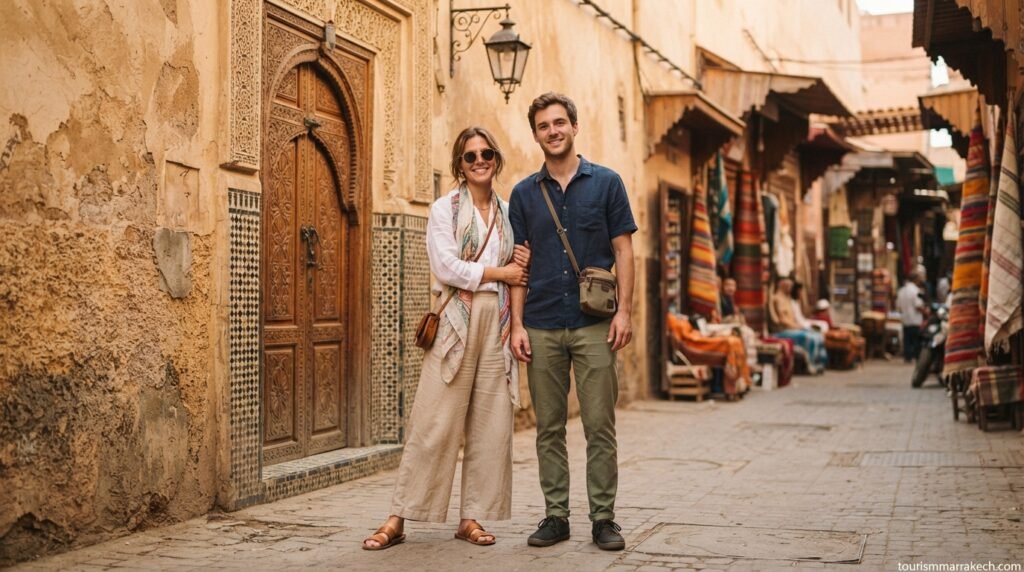
Whether you are male or female, loose, light-coloured clothing is both culturally respectful and practically cooler in summer. Avoid anything you would be uncomfortable having photographed without context in a conservative neighbourhood. Bright prints and tourist-branded clothing are common and perfectly fine — the point is coverage and comfort, not invisibility.
What to Wear in Summer
Lightweight, breathable fabrics — linen, cotton, bamboo blends — are essential in July and August. Loose trousers are cooler than shorts in very hot, sunny conditions because they protect your legs from direct sun exposure. A wide-brimmed hat, sunglasses, and regular sunscreen application are essential rather than optional.
What to Wear in Winter
December through February requires layering. Days can be comfortable and warm in the sun, but evenings drop sharply. A mid-weight jacket, a warm layer for evenings, and comfortable closed-toe shoes for navigating the medina lanes are necessary. A scarf is useful both for warmth and cultural respect.
Shoes and Sun Protection
Comfortable, well-fitting walking shoes are among the most important items in your packing list for Marrakech. The medina’s streets are uneven, often cobbled, sometimes wet, and long. Sandals are fine for evenings and casual walks, but trainers or supportive walking shoes are better for a full day of exploring. Blisters are one of the most common complaints of first-time visitors who underestimated how much ground they would cover.
Safety Tips and Common Scams in Marrakech
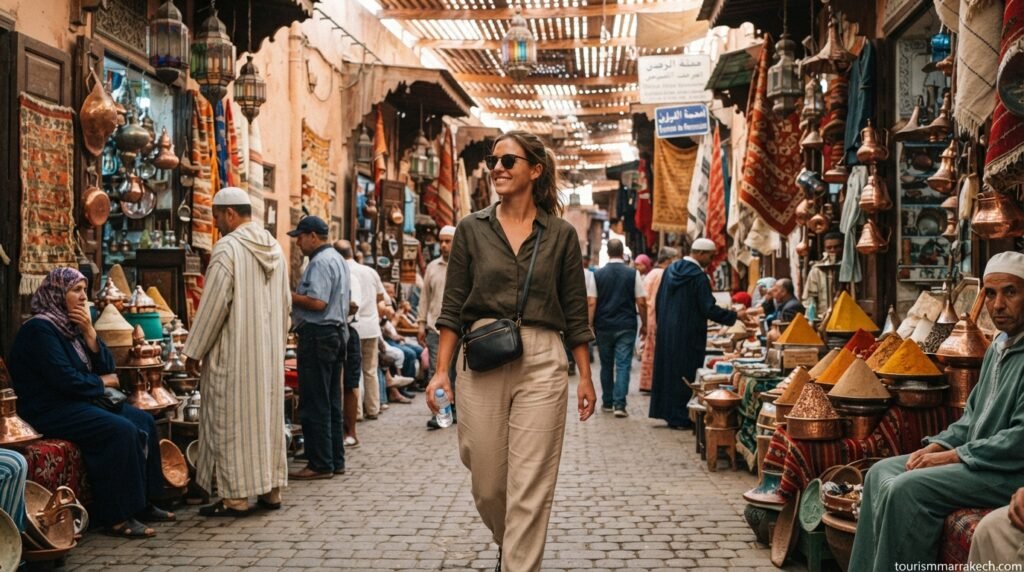
Quick Answer: Marrakech is generally safe for tourists and receives large numbers of international visitors each year. The US State Department currently classifies Morocco as a Level 1 destination (exercise normal precautions). Visitors should use the same awareness they would in any busy tourist city — the main risks are petty theft and tourist-targeted scams rather than serious crime.
The Moroccan government invests significantly in tourist security, and police presence in the main tourist areas is visible. That said, a city that receives millions of visitors annually will inevitably attract those who try to take advantage of them. Knowing the most common situations in advance means you can respond calmly rather than with confusion.
For current official travel advice, consult the UK FCDO Morocco travel advice or the US State Department’s Morocco travel advisory before your trip.
Pickpocketing
Pickpocketing occurs in dense crowd environments — principally Jemaa el-Fna during the evening, the busiest souk lanes, and areas around popular attractions. A cross-body bag worn in front, or a secure daypack with zip pockets, substantially reduces your risk. Avoid putting your phone or wallet in an open pocket or leaving your bag behind you while eating at a crowded terrace.
Unsolicited “Guides”
This is the most common issue first-time visitors encounter in the medina. A friendly stranger approaches, offers to show you the way to your hotel or the main square, and then leads you to a shop where they receive a commission. The introduction is almost always friendly and hard to recognise immediately.
The best response is to be politely firm: “Thank you, I know the way.” If you genuinely want a guide, book one through your riad or through a licensed private tour service.
The “Street Is Closed” Scam
A stranger tells you that the street leading to your destination is closed for a ceremony, construction, or similar reason, and offers to show you an alternative route — which leads via a carpet or souvenir shop. The street is almost never actually closed. Simply say thank you and continue in your intended direction.
Taxi Overcharging
Some taxi drivers quote inflated flat rates to tourists rather than using the meter. Always confirm either the meter will be used or agree on a reasonable fare before the journey starts. If you are unsure of the normal fare for a route, ask your riad in advance.
Henna Scams
Women in Jemaa el-Fna or the main medina lanes sometimes approach tourists and begin applying henna without a clear price discussion first. Once applied, they charge prices far above what was implied or expected. If you want henna, agree on the full design and the exact price in advance and in writing if possible.
Photo Charges
Snake charmers, musicians, people in traditional costume, and some stall holders in Jemaa el-Fna expect payment if you photograph them or their animals. This is entirely reasonable — simply agree on a price before taking any photo, or be prepared to pay a requested amount after. Photographing someone and then arguing about payment creates unnecessary conflict.
Shop Commissions
If someone who works for your riad or a tour company “recommends” a specific shop with particular enthusiasm, be aware that referral commissions are common. This does not mean the shop is necessarily bad — it just means you should not assume the recommendation is entirely impartial. Shop around and compare before committing to any significant purchase.
Fake Helpful Strangers
Genuinely helpful locals do exist — and many Marrakchis are enthusiastically hospitable. The difference is usually context: a genuine local responding to a specific question is different from an unprompted approach in a tourist area with a specific suggestion. Trust your instincts, and if something feels forced or structured toward a particular outcome, it probably is.
| Situation | What Happens | How to Respond |
|---|---|---|
| Unsolicited guide offer | Friendly offer to show you around leads to commission shops | Politely decline; say “thank you, I know the way” |
| “Street is closed” | Diverts you via a souvenir shop | Continue on your route; the street is rarely closed |
| Henna application | Applied without price agreed; excessive charge demanded | Agree price and design in advance or decline firmly |
| Taxi flat-rate inflation | Driver quotes significantly more than the metered fare | Confirm fare before entering; ask your riad for guidance |
| Photo charge | Photo taken; aggressive demand for payment follows | Ask price before photographing; be prepared to pay if you do |
| Free mint tea “gift” | Shop owner offers tea; pressure to buy follows | You are not obligated to buy; you can accept tea and leave politely |
| Riad “full” misdirection | Stranger claims your riad is full; offers alternative (his friend’s hotel) | Contact your riad directly to confirm; never follow a stranger to alternative accommodation |
Solo Female Traveller Safety
Marrakech is visited by large numbers of solo female travellers every year, and with reasonable precautions, it is a manageable and rewarding destination. Verbal attention — unsolicited comments, persistent approaches — is the most commonly reported issue, particularly in the medina and around Jemaa el-Fna. Dressing modestly, walking with purpose, and responding to unwanted attention with a calm but firm “la, shukran” (no, thank you) is usually effective. Booking your accommodation in advance and having your riad’s address ready in Arabic for your arrival are practical first steps.
Evenings around Jemaa el-Fna can feel overwhelming if you are alone — having a group, or positioning yourself at a café table with a clear view of the square, gives a more comfortable vantage point.
Emergency and Tourist Assistance
Morocco’s tourist police (Brigade Touristique) operate in Marrakech and can assist visitors who have been the victim of a crime or who need help. The general emergency number in Morocco is 19 for police. Your country’s embassy or consulate can provide consular assistance in serious situations. Check your government’s travel advisory page for current contact information before you travel.
Health and Food Safety Tips
Most visitors to Marrakech experience no significant health issues. The most common complaints among first-time visitors are stomach upsets (usually mild and brief), sunburn, heat exhaustion in summer, and the occasional blister from underestimating how much walking is involved.
- Water: Do not drink tap water in Marrakech. While municipal water is treated, travellers’ digestive systems often react to local water bacteria that are not harmful to residents. Drink bottled water — it is inexpensive and widely available. Be cautious with ice in basic restaurants and street food contexts; at established hotels and restaurants it is generally fine.
- Street food: Street food in Marrakech is generally safe and delicious, particularly at busy stalls with high turnover. The key rule is: eat where locals eat, and choose stalls where you can see the food being freshly prepared. Avoid pre-prepared food sitting in the open heat for unknown periods.
- Raw foods: Salads and raw vegetables at lower-end establishments may have been washed in tap water. At tourist-grade restaurants and riads this is typically managed appropriately, but if your stomach is sensitive, stick to cooked food for the first few days.
- Heat and hydration: In summer especially, drink water consistently throughout the day even if you do not feel particularly thirsty. Heat exhaustion is a real risk when walking extensively in temperatures above 35°C. Rest during the hottest midday hours, seek shade, and wear sun protection.
- Sun protection: High-SPF sunscreen, a hat, and sunglasses are essential in all seasons — the Moroccan sun is powerful even in winter. Reapply sunscreen regularly, particularly after sweating.
- Travel insurance: Comprehensive travel insurance covering medical expenses, emergency evacuation, and trip disruption is strongly recommended. Medical facilities in Marrakech are adequate for most needs, but serious cases may require evacuation to Casablanca or Europe.
- Pharmacies: Marrakech has numerous well-stocked pharmacies (identified by the green cross symbol), and pharmacists can often advise on minor ailments and over-the-counter remedies. For guidance on specific health requirements for Morocco, consult your own country’s national health service or the World Health Organization before travel.
Cultural Etiquette and Local Customs
Greetings
Greetings are important in Moroccan culture and are taken seriously. The standard Islamic greeting — As-salamu alaykum — translates as “peace be upon you” and is widely used. Responding with Wa alaykum assalam is appreciated. Handshakes are the norm for formal introductions between men; between men and women the convention varies and it is generally respectful to let the Moroccan person initiate physical contact.
Darija and French
Morocco is officially an Arabic and Amazigh (Berber) speaking country, but the reality on the ground is multilingual. Moroccan Arabic — known as Darija — is the everyday spoken language in Marrakech. French is widely understood in hotels, restaurants, and business contexts, as Morocco was under French protectorate until 1956. English is spoken by many people in tourist-facing roles but is not universal. Even a few words of French or Darija make a very positive impression. For more context on the languages you will encounter, see our overview of languages spoken in Morocco.
Basic Moroccan Phrases
| English | Darija (Moroccan Arabic) | Notes |
|---|---|---|
| Peace be upon you (hello) | As-salamu alaykum | Universal greeting |
| And upon you peace (response) | Wa alaykum assalam | Standard response to greeting |
| Thank you | Shukran (شكراً) | Widely understood across Morocco |
| No, thank you | La, shukran | Essential for politely declining persistent vendors |
| How much is this? | Bshhal hada? (بشحال هذا؟) | Key phrase for the souks |
| Good / OK | Mezyan (مزيان) | Positive affirmation |
| Yes | Iyeh (إيه) | Informal affirmative |
| Excuse me / Sorry | Smeh liya (سمح ليا) | Useful in crowds and markets |
| Please | Afak / Min fadlak (من فضلك) | Both forms are understood |
| Where is…? | Fin kayn…? (فين كاين؟) | Useful for navigation |
Photography
Marrakech is extraordinarily photogenic, and you will want to photograph almost everything. The etiquette is straightforward: photograph buildings, landscapes, and public spaces freely, but always ask permission before photographing individual people. Many locals are happy to be photographed and some actively enjoy it; others prefer privacy or request a small payment. Respect either response without argument.
Mosques and Religious Sites
Most of Morocco’s active mosques are not open to non-Muslim visitors. The Koutoubia Mosque in Marrakech is the most prominent example — its exterior and gardens are beautiful and freely accessible, but entry to the prayer hall is not permitted for non-Muslims. This is not unique to Marrakech or Morocco — check access policies before approaching any mosque. The Ben Youssef Madrasa, by contrast, is a historic Quranic school that is open to all visitors and is one of the most visually stunning sites in the medina.
Friday
Friday is the Islamic day of prayer and affects the rhythm of the city, particularly around midday. Some smaller shops may close for the Friday prayer period. The main tourist attractions and most restaurants remain open, but expect a slightly different pace during Friday morning and early afternoon.
Eating Customs
Moroccan hospitality around food is genuine and generous. If invited to share a meal in a home, accepting is the warmest response you can give. Food is traditionally eaten from a shared central dish; the right hand is conventionally used. Do not be surprised if significantly more food appears than seems possible to finish — this is an expression of welcome.
Mint Tea
Moroccan mint tea — atay in Darija — is an institution. Offered at the start of a meal, during a shop negotiation, and as a simple gesture of hospitality, it is a ritual as much as a drink. Accepting tea is socially gracious; it does not create a commercial obligation, though some shop owners use it as the first step in a sales process. Enjoy it — it is genuinely good.
Public Displays of Affection
Morocco is a predominantly Muslim country with conservative social norms around public physical affection. Holding hands between couples is generally accepted in tourist areas and modern districts like Gueliz; more visible affection is culturally inappropriate in the medina and in traditional public settings. Same-sex couples should be aware that public displays of affection carry both social and legal risks in Morocco.
Top Things to Do in Marrakech
This section focuses on practical tips for visiting the city’s main attractions rather than a full sightseeing guide — for a comprehensive overview, see our dedicated guide to the top things to do in Marrakech. For unusual and lesser-known experiences, our hidden gems in Marrakech guide is worth exploring.
Jemaa el-Fna
The great square at the heart of the medina is a UNESCO-recognised cultural space and the most famous gathering point in North Africa. It transforms through the day: quiet food stalls and orange juice vendors in the morning, snake charmers and musicians in the afternoon, and an enormous open-air feast of food stalls, acrobats, and storytellers after sunset. Visit at different times of day — the contrast is extraordinary. Practical tip: If you sit at a food stall, check the price list before ordering. Tourist pricing can be significantly higher than what is displayed.
Marrakech Souks
The medina’s souks are organised loosely by trade — there are separate areas for leather goods, carpets, spices, lanterns, metalwork, and ceramics. Allow at least half a day to explore without a shopping agenda first; the experience of getting (pleasantly) lost is part of the appeal. Bring cash, keep your phone secure, and do not feel pressured to buy at the first stall.
Bahia Palace
A 19th-century palace complex of extraordinary decorative detail — carved stucco, zellige tilework, painted cedar ceilings, and internal gardens. It is among the finest examples of Moroccan architectural craftsmanship in Marrakech. Visit early morning to beat the tour groups. Allow 45 minutes to an hour.
Ben Youssef Madrasa
This 14th-century Quranic school (closed for centuries and then restored for visitors) is architecturally breathtaking — intricate carved plasterwork, a marble courtyard, and galleries of student cells arranged around a central pool. It is one of the most photographed interiors in Morocco. Arrive when the gates open to have the courtyard to yourself. Allow 30–45 minutes.
Saadian Tombs
The mausoleum of the Saadian dynasty, sealed for centuries and rediscovered in 1917. The Chamber of the Twelve Columns is the centrepiece — an ornate burial hall of astonishing craftsmanship. The site is small and can feel crowded; early morning or late afternoon visits are most comfortable. Allow 20–30 minutes.
Koutoubia Mosque
The 12th-century Koutoubia Mosque is Marrakech’s most recognisable landmark — its minaret is visible from much of the city and served as the architectural model for the Giralda in Seville. Non-Muslim visitors cannot enter, but the surrounding gardens are peaceful and the exterior is beautiful, particularly at dusk when the call to prayer sounds. Take a slow evening walk around the gardens.
El Badi Palace
The ruins of a once-magnificent 16th-century palace destroyed by order of the Alaouite sultan Moulay Ismail in the 17th century. What remains — vast sunken gardens, original marble columns, and the scale of the original structure — is still evocative. Storks nest on the walls from spring onwards. Allow 45 minutes to an hour.
Jardin Majorelle
Created by French artist Jacques Majorelle and later purchased and restored by Yves Saint Laurent, the Jardin Majorelle is among the most visited gardens in Africa. The electric-blue building housing the Berber Museum, the extraordinary cactus collections, and the overall colour palette make it uniquely photogenic. Book tickets online in advance — the garden operates a timed-entry system and sells out, particularly on weekends and in high season. Allow 1.5 to 2 hours. The adjacent Yves Saint Laurent Museum is worth adding if you have an interest in fashion and design history.
Le Jardin Secret
A beautifully restored 19th-century private garden hidden within the medina itself. Smaller than Jardin Majorelle and less well-known, it offers a tranquil retreat from the surrounding lanes. The rooftop terrace has excellent views over the medina rooftops. Allow 45 minutes to an hour.
Maison de la Photographie
A curated collection of historical photographs documenting Morocco from the 1870s to the 1950s, housed in a beautifully restored medina building with rooftop café views. One of Marrakech’s most underrated cultural stops. Allow 1 hour.
Traditional Hammam
A traditional hammam experience — steam, scrubbing, and massage — is one of the most authentically Moroccan things a visitor can do. Most riads can arrange a private hammam session, or you can visit a public hammam (more affordable and more local, but requiring some language confidence). A full treatment typically takes 1.5 to 2 hours. It is not just a wellness activity — it is a centuries-old social institution.
💡 Pro Tip: To plan your medina sightseeing efficiently without hiring a guide, our self-guided walking tour of Marrakech connects the medina’s main monuments in a logical sequence.
Food and Dining Tips in Marrakech
Moroccan cuisine is one of the most complex and rewarding food traditions in the world — influenced by Berber, Arab, Andalusian, and sub-Saharan African cooking over many centuries. Visiting Marrakech is a genuine opportunity to eat extraordinarily well.
Moroccan Foods to Try
- Tagine: Morocco’s signature slow-cooked stew — typically lamb, chicken, or vegetables with preserved lemon, olives, and aromatic spices. Every region and every family has its own version. Eaten with bread rather than a fork.
- Couscous: Traditionally served on Fridays in Moroccan homes — steamed semolina served with vegetables, chickpeas, and meat in a rich broth. At its best in local restaurants rather than tourist versions.
- Tanjia: A Marrakech specialty — slow-cooked lamb or beef sealed in a clay vessel and traditionally cooked in the embers of a hammam furnace. Deeply flavoured and unique to the city.
- Pastilla: A flaky pastry filled with pigeon (or chicken), almonds, and eggs, dusted with cinnamon and icing sugar. The sweet-savoury combination is extraordinary.
- Harira: A hearty tomato, lentil, and chickpea soup traditionally used to break the fast during Ramadan but available year-round. Warming, filling, and deeply Moroccan.
- Brochettes: Skewered and grilled meat — lamb, beef, or kefta — served with flatbread and harissa. A reliable and delicious street food option.
- Moroccan mint tea: Gunpowder green tea brewed with fresh mint and generous amounts of sugar, poured from height to create a foam. An essential ritual.
- Fresh orange juice: The juice stalls around Jemaa el-Fna squeeze Moroccan oranges to order for just a few dirhams per glass. Genuinely one of the best things about visiting Marrakech.
Eating in Jemaa el-Fna
The food stalls that fill Jemaa el-Fna after sunset are an experience — dozens of numbered stalls competing for business with colourful displays and enthusiastic touts. The quality varies, but busy stalls with obvious turnover are generally reliable. The most practical advice: look at the price list before sitting down, confirm what is included in any “set meal,” and pay attention to the bill. This is one of the areas in Marrakech where tourist pricing is most likely to surprise the unprepared.
Rooftop Restaurants
Marrakech’s medina has developed a strong tradition of rooftop terrace dining — restaurants accessible through a medina building that open onto stunning views across the rooftops and minarets. The food quality varies considerably; some are excellent, others rely on the view rather than the kitchen. Ask your riad for current recommendations, as the dining scene shifts.
Restaurants in Gueliz
Gueliz has Marrakech’s most international restaurant scene — European cuisine, Japanese food, contemporary Moroccan cooking, wine lists, and cocktail bars are all available. If you are spending several days in Marrakech, mixing medina dining experiences with evenings in Gueliz provides a more complete picture of the city’s food landscape.
Vegetarian and Dietary Considerations
Vegetarian visitors can eat well in Marrakech — tagines with vegetables, couscous with seven vegetables, harira, and countless salad and mezze options are all widely available. Vegan visitors have a slightly narrower selection in traditional restaurants, where butter and ghee appear frequently, but dedicated vegetarian and vegan options have grown in Gueliz. Visitors with serious dietary restrictions or allergies should communicate clearly with restaurant staff — translation apps are useful for conveying specific requirements.
Shopping in Marrakech Souks
Shopping in Marrakech’s souks is one of the defining experiences of any visit — but it rewards preparation. For a full overview of what to buy and where, our dedicated Marrakech shopping guide covers the souks in detail. Here is the practical foundation every first-time visitor needs.
How Haggling Works
Negotiating prices in the souks is expected and entirely normal. It is not confrontational — at its best, it is a social interaction that both sides participate in with some enjoyment. Sellers do not post fixed prices for most items, and the price quoted first is almost never the final price. The key is to approach it with good humour rather than suspicion.
Marrakech Souk Haggling Formula
- Browse without buying pressure first. Look at multiple stalls selling similar items.
- Show genuine interest in the item before asking the price.
- Ask the price: “Bshhal hada?” (“How much is this?”)
- Make a counter-offer — typically lower than what you would actually pay, leaving room to meet in the middle.
- Stay friendly and conversational throughout. If a seller finds you pleasant, they are more likely to be flexible.
- If you reach an impasse at a price higher than you want to pay, politely begin to leave. This frequently produces a better offer.
- If the final price still does not feel right to you, it is completely acceptable to walk away.
💡 Pro Tip: Never name a price you are not willing to pay. If a seller accepts your offer, the deal is made. Walking away after your price has been accepted is considered rude.
What to Buy
Marrakech’s souks offer a genuinely impressive range of quality craftsmanship. Among the most worthwhile purchases:
- Argan oil: Produced from trees native to Morocco, argan oil is used both culinarily and cosmetically. Buy from reputable cooperatives or established shops that display quality certifications, and be wary of heavily diluted products sold at extremely low prices.
- Leather goods: The tanneries of the medina produce leather bags, babouche slippers, belts, and wallets. Quality varies — examine stitching, examine the leather thickness, and ask about the tanning process if quality is important to you.
- Rugs and kilims: From simple flat-woven kilims to elaborate Berber pile rugs, the range is extraordinary. The key quality checks: look for tight, even weaving; turn the rug over to see the back (a high-quality rug looks almost identical on both sides); and ask about the materials (wool vs. synthetic).
- Lanterns: Pierced metal or coloured-glass lanterns are among the most iconic Marrakech souvenirs. Brass and copper versions are heavier but more durable; newer designs in coloured glass are lighter for travel.
- Spices: Buying spices from the spice souks — ras el hanout, cumin, saffron, dried rose petals — is an excellent value and easily packed. Buy whole spices rather than pre-ground powders where possible for better quality and authenticity.
How to Check Quality
Quality in the medina ranges from excellent handcrafted goods to cheap tourist-grade products. Take your time, examine items carefully, ask questions, and do not let a vendor rush your decision. A seller confident in their product’s quality will welcome scrutiny.
Best Day Trips From Marrakech
Marrakech’s location makes it one of the best bases in North Africa for day trips and short excursions. Within a few hours you can be in the High Atlas Mountains, on an Atlantic coastal town, or exploring a UNESCO World Heritage kasba. Our dedicated page on day trips from Marrakech covers each destination in detail.
Atlas Mountains
The High Atlas rises dramatically south of Marrakech and is visible from the city on a clear day. Valleys, Berber villages, and Morocco’s highest peak — Jebel Toubkal — are all within reach. Even a half-day drive into the foothills offers an extraordinary contrast to the urban intensity of the medina.
Ourika Valley
One of the closest escapes from the city, the Ourika Valley lies about 35 kilometres southeast of Marrakech. The drive follows a river valley into the Atlas foothills, passing Berber villages and small market towns. It is most dramatic when the Atlas peaks are snow-capped in winter and spring.
Imlil
A small mountain village that serves as the gateway for treks toward Jebel Toubkal (4,167m). Even without ambitious hiking plans, Imlil itself — at around 1,740m — offers cool air, mountain scenery, and excellent traditional food. A comfortable day trip from Marrakech.
Agafay Desert
Often called a “stone desert,” the Agafay is a rocky plateau of lunar landscape about 40 kilometres west of Marrakech. It offers a taste of the Moroccan desert without the long journey required to reach the Sahara — including camel rides, quad biking, and sunset glamping experiences. A popular half-day or full-day excursion. Check out our guide to the best excursions from Marrakech for current operators.
Essaouira
Morocco’s charming walled Atlantic port city is approximately 2.5 to 3 hours from Marrakech by road. It has a completely different energy from the medina — sea breezes, blue-and-white architecture, excellent fresh fish, a creative arts scene, and famous windsurfing beaches. A day trip is feasible but one or two nights allows for a more relaxed experience.
Ouzoud Waterfalls
The Ouzoud Falls are Morocco’s most spectacular waterfall — three tiers dropping approximately 110 metres into a green gorge, framed by ancient olive trees and inhabited by a resident population of Barbary macaques. Approximately 2.5 hours from Marrakech. A full day trip; swimming in the natural pools below the falls is possible in summer.
Ait Benhaddou
A UNESCO World Heritage-listed fortified village (ksar) on the ancient caravan route between the Sahara and Marrakech. Its red-earth architecture has served as a backdrop for numerous major films. About 3 hours by road — best combined with a longer southern Morocco itinerary rather than a rushed day trip.
Sahara Desert
Reaching the iconic sand dunes of Erg Chebbi near Merzouga requires approximately 8–10 hours of driving each way from Marrakech. This is not a day trip — plan at least 3 days minimum to justify the journey and actually experience the desert. A Marrakech desert trip of 3 to 5 days allows you to combine Ait Benhaddou, the Dades Gorge, and the dunes in a single loop.
| Destination | Approx. Travel Time | Best For | Recommended Trip Length |
|---|---|---|---|
| Ourika Valley | ~45–60 min | Easy nature escape; Berber villages | Half day or full day |
| Agafay Desert | ~40–50 min | Desert scenery; activities; sunset | Half day or full day |
| Imlil / Atlas Mountains | ~1–1.5 hrs | Mountain scenery; hiking; cool air | Full day |
| Ouzoud Waterfalls | ~2.5 hrs | Waterfalls; swimming; macaques | Full day |
| Essaouira | ~2.5–3 hrs | Coastal town; seafood; culture | Full day or 1–2 nights |
| Ait Benhaddou | ~3 hrs | UNESCO kasba; film history | Full day minimum; better as overnight |
| Sahara Desert (Merzouga) | ~8–10 hrs | Dunes; camel trekking; stargazing | Minimum 3 days recommended |
Suggested Marrakech Itineraries
3-Day Marrakech Itinerary
Day 1: Medina Orientation
Start slowly — the medina rewards exploration without a rigid schedule. Walk the main souk lanes in the morning, visit Ben Youssef Madrasa before the crowds arrive, have lunch at a local restaurant near the northern medina, and spend your afternoon exploring the leather souk and the spice market. End the day at Jemaa el-Fna — arrive around 5pm to watch the square transform from its daytime version into the evening spectacle. Dinner at one of the food stalls or a nearby restaurant with a terrace view over the square.
Day 2: Monuments, Gardens and Hammam
Begin at the Saadian Tombs when they open — the early visit means smaller crowds. Walk to El Badi Palace for its atmospheric ruins. After lunch, take a petit taxi to the Jardin Majorelle (book tickets in advance online). Combine with the Yves Saint Laurent Museum if time allows. Return to your riad for a late afternoon hammam session. Dinner at a traditional Moroccan restaurant in the medina — ask your riad for their current recommendation.
Day 3: Day Trip or Slow Medina Morning
Use your third day for a half-day excursion to the Ourika Valley or Agafay Desert, or spend the morning exploring the parts of the medina you haven’t yet reached — Le Jardin Secret and the Maison de la Photographie are both worthwhile and manageable in a morning. An afternoon of unhurried shopping in the souks, with the benefit of already knowing what you like and what it costs, often produces the best purchases.
5-Day Marrakech Itinerary
- Day 1: Arrival, medina orientation, Jemaa el-Fna evening.
- Day 2: Northern medina — Ben Youssef Madrasa, souk exploration, Maison de la Photographie.
- Day 3: Southern medina monuments — Bahia Palace, El Badi Palace, Saadian Tombs. Hammam in the afternoon.
- Day 4: Full day trip — Essaouira or Ouzoud Waterfalls.
- Day 5: Jardin Majorelle and YSL Museum in the morning; Gueliz for lunch and afternoon browsing; leisurely final evening in the medina.
7-Day Morocco Trip Based in Marrakech
With a full week, you can explore Marrakech thoroughly and combine it with Morocco’s wider highlights.
- Days 1–3: Marrakech medina — monuments, souks, hammam, food, and an Agafay sunset experience.
- Day 4: Day trip to the Ourika Valley or Atlas foothills for fresh mountain air.
- Day 5: Full day in Essaouira — depart early, return late afternoon.
- Day 6: Rest day or unhurried Gueliz exploration — contemporary art galleries, excellent café breakfast, and the relaxed pace of the modern city.
- Day 7: Final medina morning — any remaining sights or shopping — before departure.
For families planning a week, our guide to Marrakech family activities provides tailored suggestions for different age groups. For a broader view of Morocco beyond Marrakech, see our overview of things to do in Morocco.
Marrakech Packing List
| Category | Items |
|---|---|
| Essentials | Passport (and digital copy stored separately); travel insurance documents; accommodation confirmations; any required visas |
| Clothing | Lightweight, breathable tops and trousers; modest cover-ups for the medina; layer for cool evenings; swimwear (for riad/hotel pool); comfortable walking shoes; sandals for evenings; wide-brimmed hat; scarf (multipurpose) |
| Electronics | Phone charger; European-style power adapter (Morocco uses Type C/E sockets); portable battery pack; earphones |
| Health | High-SPF sunscreen; sunglasses (good quality, UV-protective); lip balm with SPF; personal medications; basic first aid items; stomach remedies; insect repellent (spring/summer); hand sanitiser |
| Useful Extras | Reusable water bottle; offline maps downloaded; eSIM or local SIM (Maroc Telecom, Orange, Inwi all available in Marrakech); small cross-body bag for daily use; small wallet for cash; basic French phrasebook or translation app |
Morocco uses Type C and Type E power sockets with 220V power. UK three-pin plugs and US two-pin plugs both require an adapter.
💡 Pro Tip: An eSIM is the most convenient way to have data from the moment you land in Marrakech. Alternatively, local SIM cards from Maroc Telecom, Orange, or Inwi are inexpensive and available at the airport and throughout the city.
Frequently Asked Questions About Marrakech Travel Tips
Is Marrakech safe for tourists?
Marrakech is generally safe for tourists, and large numbers of international visitors travel there each year without incident. The US State Department currently classifies Morocco as a Level 1 destination (exercise normal precautions). The main risks for tourists are petty theft in crowded areas and tourist-targeted scams rather than serious crime. Using normal urban awareness — keeping valuables secure, confirming prices in advance, and being cautious with unsolicited offers — is sufficient for most visitors.
How many days do you need in Marrakech?
Three full days is the minimum to cover Marrakech’s main sights without feeling rushed. Four to five days allows a more relaxed pace plus a day trip. If you want to combine Marrakech with the Atlas Mountains, Essaouira, or the Sahara, plan for a week or more.
What should I know before visiting Marrakech?
The most important things to know: the medina is not navigable by car (you will walk a lot); the dirham is the only accepted currency in most of the medina; negotiating prices is normal and expected in the souks; modest dress is appropriate in traditional areas; and the gap between tourist pricing and local pricing is real — knowing approximate costs in advance saves money and frustration.
What should I wear in Marrakech?
Lightweight, breathable clothing that covers shoulders and knees is appropriate in the medina and around religious sites. In hotels, modern restaurants, and Gueliz, the dress code is more relaxed. Comfortable walking shoes are essential. In summer, add a hat and high-SPF sunscreen to every day’s essentials.
Is Marrakech expensive?
Marrakech offers good value by Western European and North American standards. Budget travellers can live comfortably on the equivalent of $40–70 USD per day. Mid-range travellers spending $80–180 USD per day can stay in excellent riads, eat very well, and experience most major attractions. Luxury experiences are available but at international luxury prices.
Do I need cash in Marrakech?
Yes. Cash is essential for navigating the medina, the souks, street food, hammams, tipping, and taxis. While cards are accepted in larger restaurants, hotels, and some shops in Gueliz, do not rely on card payments for your daily needs. ATMs are widely available throughout the city.
Should I stay in a riad or hotel?
A riad inside the medina offers a uniquely Moroccan experience — courtyard atmosphere, personalised service, and proximity to the major sights. A hotel in Gueliz or Hivernage offers more predictable amenities, easier taxi access, and a quieter environment. For a first visit, most people enjoy the riad experience. Families with young children or travellers with mobility considerations may find a hotel more practical.
Do I need a guide in Marrakech?
A licensed guide is not mandatory, but for a first visit to the medina a guided morning is genuinely valuable — an experienced guide can explain the historical and cultural context of what you are seeing, navigate the lanes efficiently, and help you avoid being misdirected. After one guided exploration, most visitors feel confident enough to explore independently. If you prefer to self-navigate from the start, our self-guided Marrakech walking tour provides a well-structured alternative.
Is Marrakech suitable for solo travellers?
Yes. Marrakech is a manageable solo destination for both men and women. Solo female travellers should be prepared for more frequent unsolicited attention in the medina and take standard urban safety precautions — modest dress, confident body language, and a clear sense of where you are going help considerably. For travel inspiration across Morocco, our Marrakech travel blog includes experiences from different types of traveller.
Is Marrakech suitable for families?
Marrakech works well for families who approach it with realistic expectations. Children tend to love Jemaa el-Fna, the gardens, and the tactile experience of the souks. The medina’s narrow lanes and uneven surfaces are challenging with pushchairs. Riads are often intimate spaces that do not always suit very young children — check policies and facilities carefully before booking. Our guide to Marrakech with kids covers family-specific recommendations in detail.
What is the best month to visit Marrakech?
October and November are excellent — comfortable temperatures, thinner crowds than peak spring, and the autumn light over the medina is beautiful. March and April are also popular, with pleasant weather and the gardens at their best. December through February is good for lower prices and uncrowded attractions; just pack for cold evenings.
Can I drink tap water in Marrakech?
No — drink bottled water throughout your trip. This is the single most effective way to avoid the stomach upsets that affect a small but significant number of first-time visitors. Bottled water is inexpensive and available everywhere.
Is Uber available in Marrakech?
As of 2026, Uber has relaunched in Marrakech in a limited capacity after previously leaving Morocco in 2018. However, availability can vary and should not be relied upon as your primary transport option. inDrive is currently the most consistently available ride-hailing app in Marrakech. Petit taxis remain the most reliable everyday option for short city journeys.
How do taxis work in Marrakech?
Petit taxis (small city taxis) operate within Marrakech and should use their meters or agree a fare in advance. Grand taxis are larger shared vehicles used for intercity routes or private day-trip hire. At Marrakech Menara Airport, a prepaid taxi counter operates in the arrivals area where you pay a fixed fare by destination. Always confirm fares before starting any journey.
What are the best day trips from Marrakech?
The best day trips depend on your interests. Nature lovers will enjoy the Ourika Valley and Ouzoud Waterfalls. Adventure seekers gravitate to the Agafay Desert and Imlil trekking village. Culture and history enthusiasts should prioritise Essaouira and Ait Benhaddou. Our dedicated best day trips from Marrakech guide covers all options with detailed practical information.
How long does it take to reach the Sahara from Marrakech?
The Sahara’s most iconic dunes — the Erg Chebbi near Merzouga — are approximately 8–10 hours from Marrakech by road. This is not a day trip under any realistic definition. Plan a minimum of three days to make the journey worthwhile; a five-day itinerary allows for stops at Ait Benhaddou, the Dades Gorge, and a night in the desert. See our full guide to planning a desert trip from Marrakech for detailed itinerary options.
💡 Final Thought: Marrakech rewards visitors who slow down. The medina is not a checklist — it is an environment to inhabit. Leave space in your itinerary for unexpected discoveries, spontaneous conversations over tea, and the pleasure of getting slightly lost in a place that has been doing this to visitors for centuries. The Marrakech travel advice that matters most is simply this: arrive curious, stay respectful, and the city will take care of the rest.
3 Comments